One Card In, One Account Out: The Two-Account Setup That Makes Bookkeeping Take Ten Minutes a Month
Which accounts to open, the rules that keep them clean, and what three months of a properly separated pool route actually looks like — with the real screens, the real numbers and the mistakes that cost the most.
In this article
- Key takeaways
- The accounts, and what each one is actually for
- What clean looks like, in numbers
- The source column is the whole trick
- Owner draws are not expenses. This is the mistake that costs the most.
- What you can see once the account is clean
- Common mistakes we see in real files
- Which record counts as income
- The ten-minute month
- Does this matter legally?
- FAQ
- Start with the accounts, then the tool
The single cheapest bookkeeping upgrade available to a small service business is not software. It is a second debit card. One business checking account that every payment lands in, one credit card that every business purchase goes on, and a rule you keep even when it is inconvenient: nothing personal touches either one. Do that and the monthly books stop being an archaeology project. Skip it and no tool on earth can tell your fuel from your groceries, because by the time the data reaches the tool the two are already the same shape.
This is the practical version of that setup: which accounts to open, what each one buys you, the rules that keep them clean, and what the year looks like at tax time when they are. The screenshots come from Daily Invoice Maker, our own desktop app, running against a demo file for a fictional pool route we set up specifically to write this piece. Every figure below is from that file.
Key takeaways
- Two accounts minimum. One checking account for money coming in, one credit card for money going out. A third — a savings sub-account for tax — is worth opening the same day.
- The rule is the product, not the account. An account you occasionally buy lunch on is not a business account; it is a personal account with a business name on it.
- Pay yourself by transfer, on a schedule. An owner draw is not an expense and must never be categorised as one.
- Do not put a business purchase on the personal card "just this once". That is a real deduction you will probably never claim.
- Reconcile monthly, not in April. Twelve months of clean statements takes about ten minutes each. One year of mixed statements takes a weekend and still ends in guesses.
The accounts, and what each one is actually for
Most advice stops at "keep business and personal separate", which is true and useless. Here is the specific shape, and what each account earns its keep doing.
| Account | What goes in it | What it buys you |
|---|---|---|
| Business checking | Every customer payment: card settlements, Zelle, cheques, cash deposits. Merchant and bank fees come out of it. | One statement that is your revenue. No adding up four apps and hoping. |
| Business credit card | Every business purchase: parts, fuel, chemicals, insurance, subscriptions, tools. | One statement that is your deductible spend, itemised by merchant, arriving monthly whether you file it or not. |
| Tax savings (sub-account) | A transfer of 25–30% of every deposit, standing order, on the day it lands. | January is a payment, not a crisis. Money you have already moved is money you cannot spend twice. |
| Personal checking | Your owner draw arrives here. Nothing business ever leaves from here. | A clean line between what the business earned and what you took home. |
A card rather than a debit card for the spending side, if your credit allows it. Not for the points. A credit card statement is a complete, itemised, dated list of everything you bought, delivered on a fixed day, with a dispute process behind it. A debit card gives you the same information mixed into the same statement as your income, and no chargeback rights worth having.
What clean looks like, in numbers
Our demo route ran three months on exactly this setup: deposits into a business checking account, purchases on a business card. Here is the summary the app produced from those statements with no manual entry at all.

Gross income $14,880.00 across 16 deposits. Total expenses $5,358.10. Net $9,521.90. And $7,428.35 of "non-taxable transfers" sitting on its own — $7,200 of owner draws plus $228.35 of personal charges that landed on the business card anyway, because real life. The point is not that the mistakes vanished. The point is that they are separately visible and separately labelled, so they do not quietly become either revenue or a deduction.
The source column is the whole trick
When each import comes from one account, every row carries where it came from, and the ledger stops being a list of purchases and becomes a list of purchases with provenance.
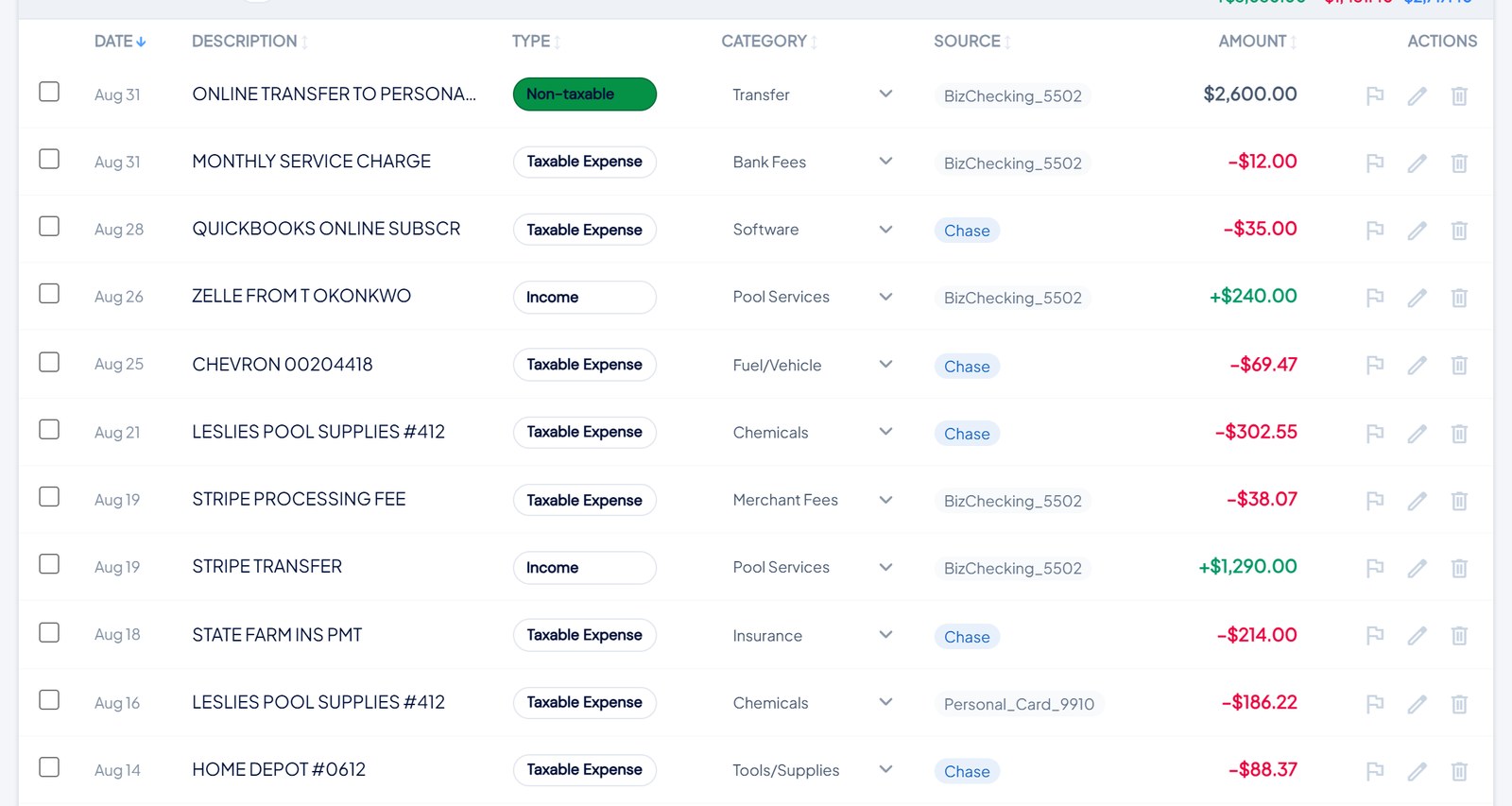
Look at the Aug 16 row: $186.22 at Leslie's Pool Supplies, on Personal_Card_9910. That is a completely legitimate business expense, and it is the single most likely deduction in this whole file to be lost — because it is on a statement nobody imports, next to the groceries. At a 22% marginal rate plus self-employment tax, forgetting it costs roughly $55. Do that twice a month and the "just this once" habit is a $1,300-a-year habit.
Owner draws are not expenses. This is the mistake that costs the most.
When you move $2,600 from the business account to your personal account, nothing has been spent. You have moved your own money between two of your own pockets. It is not a deduction, it does not reduce your profit, and categorising it as one is the fastest way to file a return that says you earned far less than you did.

The same label does the second job: the Target charge is a personal purchase that ended up on the business card. It is not a deduction either. Two very different mistakes, one correct treatment, and both handled at import rather than remembered in April.
What you can see once the account is clean
Separation is usually sold as an audit-defence measure. That undersells it. The real return is that costs you have never looked at become legible.
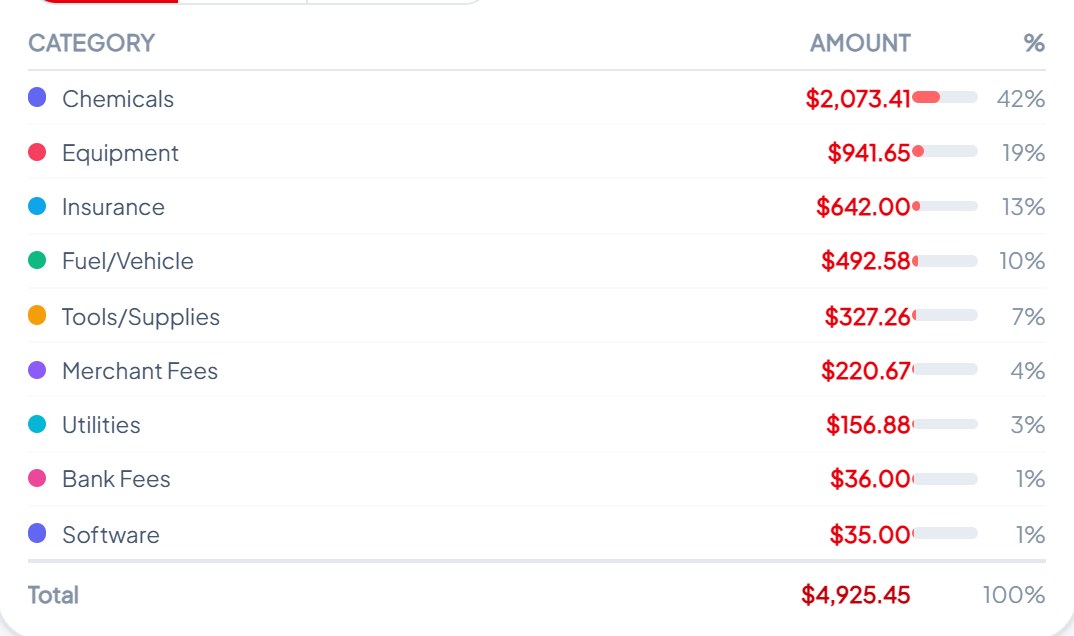
Two numbers in that list are worth a business decision. Chemicals are 42% of total spend — on a route this size, a supplier account or a bulk buy is now obviously worth a phone call. And merchant fees plus bank fees came to $256.67, about 1.7% of revenue, which is the actual price of taking cards and is invisible the moment those fees are mixed in with a household statement. Neither of those numbers exists in a commingled account. They are not hidden; they are unrecoverable.
Common mistakes we see in real files
- Importing the same purchase twice. You photograph the receipt at the counter and import the card statement, so one purchase is now two deductions. Building the receipt-capture feature taught us this is the most common self-inflicted error in a well-organised file — it happens precisely because the owner is being diligent. The app matches the pairs by amount and a ±3-day window and warns before anything is exported.
- Categorising the credit card payment. The monthly payment from checking to the card is a transfer. The purchases were already the expense. Deduct both and you have deducted your spending twice.
- Treating the deposit as revenue when a fee was taken first. A $1,290 Stripe settlement on $1,328 of sales is not $1,290 of revenue with no cost — it is $1,328 of revenue and $38.07 of fees. If you only ever see the net deposit, you are quietly understating both.
- Opening the accounts and not changing the auto-pays. The insurance renewal, the phone bill and the software subscriptions keep charging the old card for months. Move them the same week.
- One account for two businesses. A trade and a rental file on different forms. Sharing one account guarantees an afternoon of splitting the year by hand.

Which record counts as income
Here is the trap the two-account setup creates, and almost nobody warns about it. Once you have both invoices in an app and imported bank deposits, the same payment exists in two places. Add them and your revenue doubles.
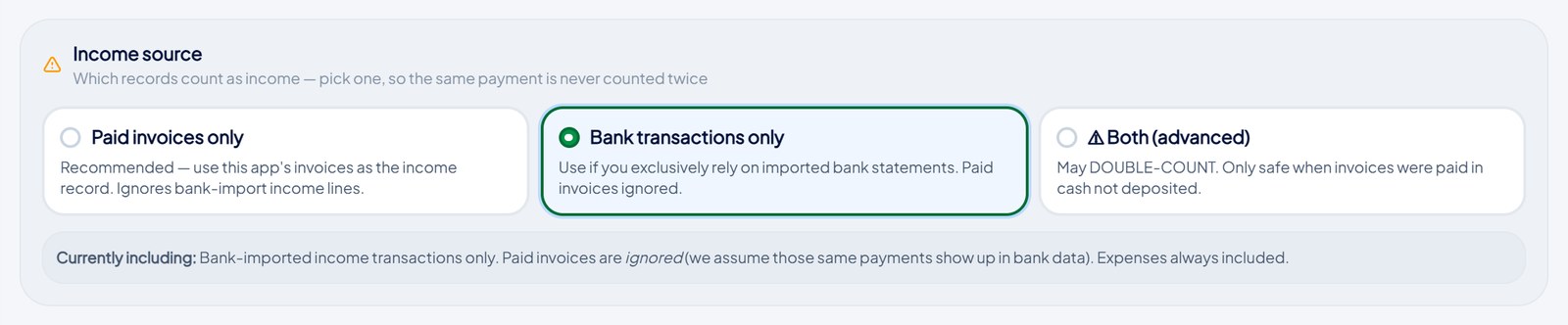
Our rule of thumb: if you invoice, count the invoices and let the deposits be the audit trail. If you do not invoice — a route that gets paid by app, a shop paid at the counter — count the deposits. "Both" is only safe when some invoices were paid in cash that never hit the bank, and even then it wants checking by hand.
The ten-minute month
What this actually looks like once it is running, on the first of the month:
- Download two statements — the checking account and the card — and import both. They arrive already separated by account.
- Skim the import review. Anything the app could not categorise is flagged; everything it has seen before is already tagged.
- Mark the owner draws non-taxable. That is usually one row.
- Clear the duplicate warning if you photographed receipts.
- Move 25–30% of the month's deposits into the tax sub-account.
That is the whole routine. The reason it takes ten minutes is not the software; it is that the sorting happened at the moment of purchase, when you chose which card to pull out. Bookkeeping is mostly a filing problem, and the filing is free if you do it with your thumb at the till.
Does this matter legally?
For substantiation, yes, and the IRS says so directly: its guidance on record-keeping for new businesses recommends a separate business checking account and warns that you must be able to show the business purpose of a deduction, not merely that money left an account. See IRS Publication 583, Starting a Business and Keeping Records. If you run an LLC there is a second reason: mixing personal and business funds is the classic fact pattern used to argue that the company is not really separate from its owner, which is the protection you formed it for.
FAQ
Do I need a business bank account if I am a sole proprietor?
You are not legally required to have one to operate as a sole proprietor in most states, but every practical argument favours it, and the IRS record-keeping guidance recommends it. A sole proprietor with a separate account has a defensible set of records; one without has a shoebox and a memory.
Can I use a personal credit card and just tag the business charges?
You can, and it is far better than nothing, but it is the setup that produces the most work per dollar. Every statement needs sorting by hand, every import needs pruning, and the charges you miss are gone. If your credit will not support a business card yet, dedicate one existing personal card to the business exclusively and stop using it for anything else — that gets you most of the benefit today.
What percentage should I set aside for tax?
25 to 30% of net profit is the usual working range for a self-employed filer covering both income tax and self-employment tax, but it depends on your bracket, your state and your other income. Set aside on the high side early in the year; you can always stop.
I have already mixed everything for eight months. What now?
Do not try to fix the year in one sitting. Open the accounts today so the remaining months are clean, then work backwards a month at a time with the card statement in front of you. In practice most people recover the bulk of the missed deductions in about two evenings, and the year splits cleanly at the date you switched.
What about cash payments?
Deposit them. Cash that never enters the business account is income you still owe tax on and cannot prove you received, which is the worst of both. Deposit it, and the deposit is the record.
Start with the accounts, then the tool
If you do one thing after reading this, it is not installing anything. It is calling your bank and opening the second account, then moving the auto-pays. The software matters after that, when clean statements need turning into a return — which is what Daily Invoice Maker does: import both accounts, keep the source on every row, split transfers from expenses, and export a Schedule C summary or a TurboTax file at year end. It runs on Windows and Mac, keeps everything in a file on your own computer, and is $149.95 once with a free demo that covers your first seven invoices, customers and expenses.
For the same topic from the personal-finance side — how to handle this when you have a W-2 job, a side income and maybe a rental, and where the tax-savings account should actually live — our sister site has a companion piece: Separating business and personal money when your income comes from three places.
Related reading: simple small-business accounting software, the full guide, and how P2P payments are taxed.
Run a service business?
Daily Invoice Maker handles invoices, estimates, expenses, route maps, agreements, and tax reports — offline, on Windows + Android. Free demo, lifetime license available.
Download free →