Handyman Billing and Invoicing Software: Materials with Receipts, Deposits, Added-On-Site Work and Property Managers
How a Chicago handyman quotes a two-day punch list with Labor and Materials sections, passes materials through at cost plus 15 percent with receipts attached, and bills a property manager monthly by work order.
In this article
- Key takeaways
- Problem 1: the punch list that keeps growing
- Problem 2: materials, receipts and markup
- Problem 3: property management work orders
- Problem 4: twenty small invoices and the ones that slip
- Problem 5: the tax return for a truck full of tools
- What goes on a handyman invoice
- What we changed after watching handymen use the app
- Common mistakes on handyman invoices
- The bottom line
- FAQ
- Try it on next week's jobs
A handyman's week is twenty small jobs and one that grows. Mount a TV, hang three fans, fix a threshold, then a two-day punch list for a condo going on the market where the client keeps adding things while you are there. The billing problems are specific: materials bought on your card that have to be passed through with receipts, a deposit for those materials, items added on site that need to be charged without an argument, and a property manager who pays on net 30 against work orders with numbers. Generic invoicing apps make you fake all of that in a description box.
This guide shows how Northside Handyman Services in Chicago handles a season of it in Daily Invoice Maker. The estimate, the invoice with materials and added-on-site work, the profit dashboard and the Schedule C summary are the app's own output for this business. The app runs on Windows, Mac and Linux ($149.95 once, $59.99 a year or $5.95 a month), works offline, and the Android app syncs with it.
Key takeaways
- Quote bigger jobs on an estimate with Labor and Materials in separate sections, a materials deposit, and the hourly rate for anything added on site written in the terms.
- Pass materials through at cost plus a stated percentage and attach the receipts to the invoice; clients accept a markup they can see and dispute one they cannot.
- Charge added-on-site work as its own "Added on site" section so the client sees the original scope and the extra, not a bigger total.
- Bill property managers monthly with the work order numbers in the description, on their terms, not yours.
- Small unpaid invoices are the handyman's cash problem; the dashboard's Outstanding figure and one-click reminder emails keep them under 30 days.
Problem 1: the punch list that keeps growing
The Mistrys are listing their condo and want the place ready: patch and paint four rooms, two bathroom faucets, three ceiling fans, a sticking front door, a new deadbolt, two closet doors. The estimate prices two days of labor at $85 an hour and lists every material item at cost plus 15 percent, with the handling percentage as its own visible line. The terms say $400 deposit for materials, and, crucially, that items added on site are billed at the hourly rate.
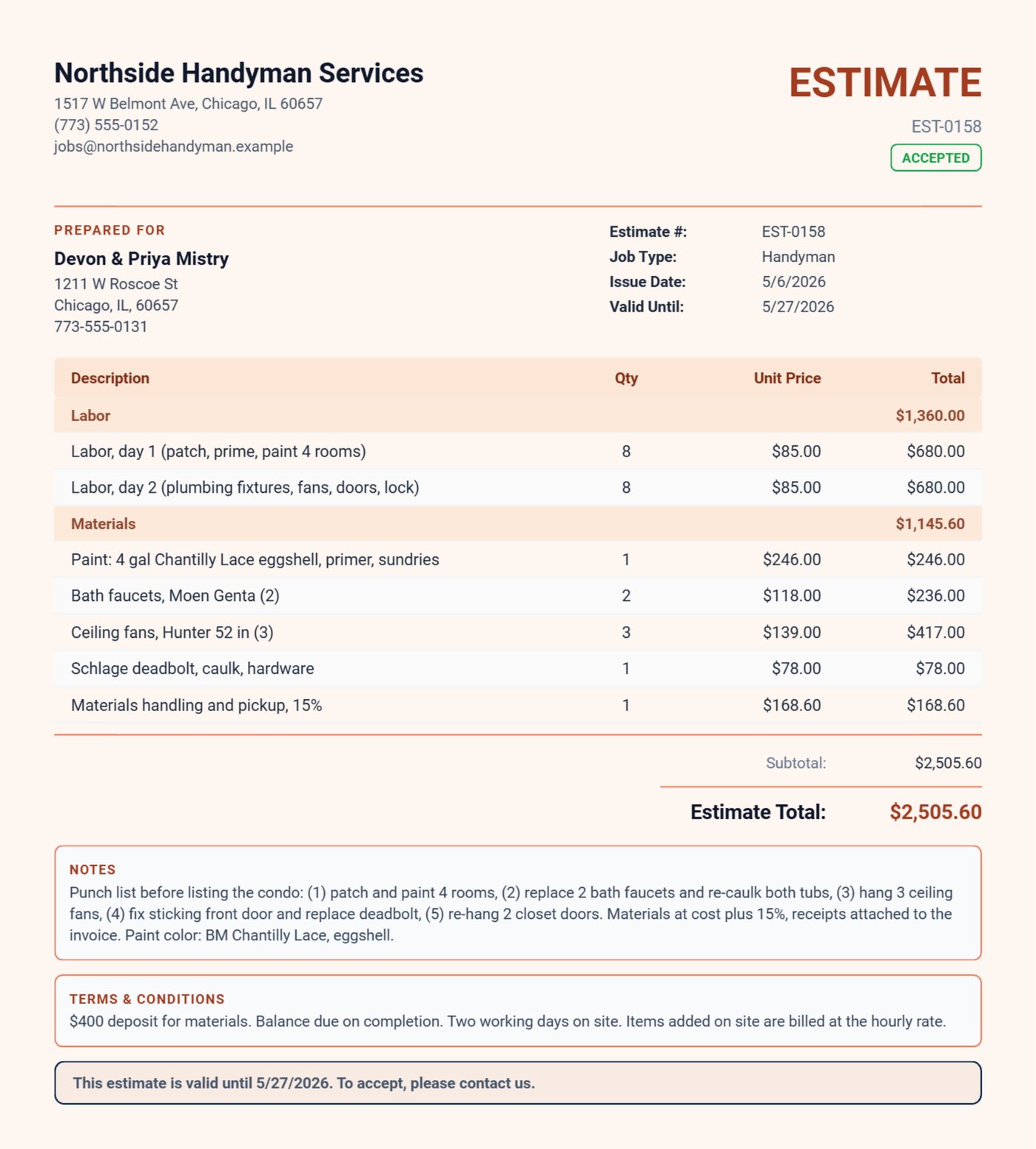
That last sentence is the one that prevents the argument on day two, when the inspector's note about the kitchen GFCI turns up. The client already agreed to the rate; the extra 30 minutes goes on the invoice under its own heading and nobody is surprised.
Problem 2: materials, receipts and markup
Handymen lose money on materials in two ways: forgetting to bill something bought on the way to the job, and marking up silently until a client checks the Home Depot price. The invoice below does it in the open. Each material is a line, the 15 percent handling is a separate line, and the receipts are attached as images. The deposit of $400 is recorded as a partial payment so the invoice shows the balance, not the total. The "Added on site" section holds the GFCI at the agreed rate.
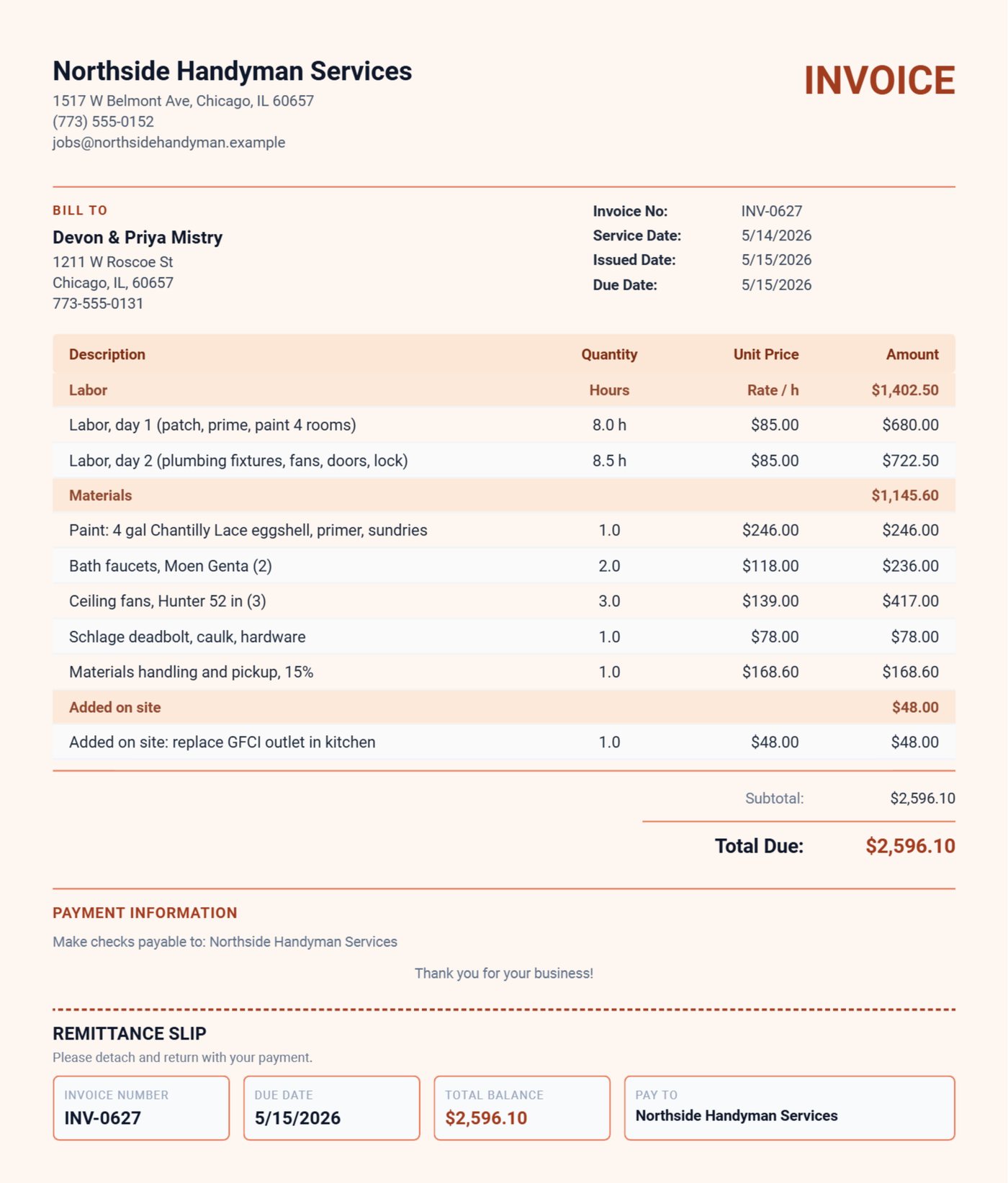
The Products & Rates list in Settings holds your hourly rate and the materials you buy repeatedly (caulk, deadbolts, fan brackets), so a line is a pick from a list, and the price is still editable on that one invoice when Menards changed it.
Problem 3: property management work orders
Lakeview Property Management sends work orders by email with numbers, and pays net 30 against a monthly invoice that references them. The March invoice reads "Work orders March: 6 units, 14.5 h total" at $80 and "Materials per attached receipts", with the WO numbers in the notes. One invoice a month, on their terms, with their references, is the difference between being paid in 30 days and being asked for a resubmission in 60. The customer record keeps the year's history so a dispute about WO 2263 is a search, not a dig through email.
Problem 4: twenty small invoices and the ones that slip
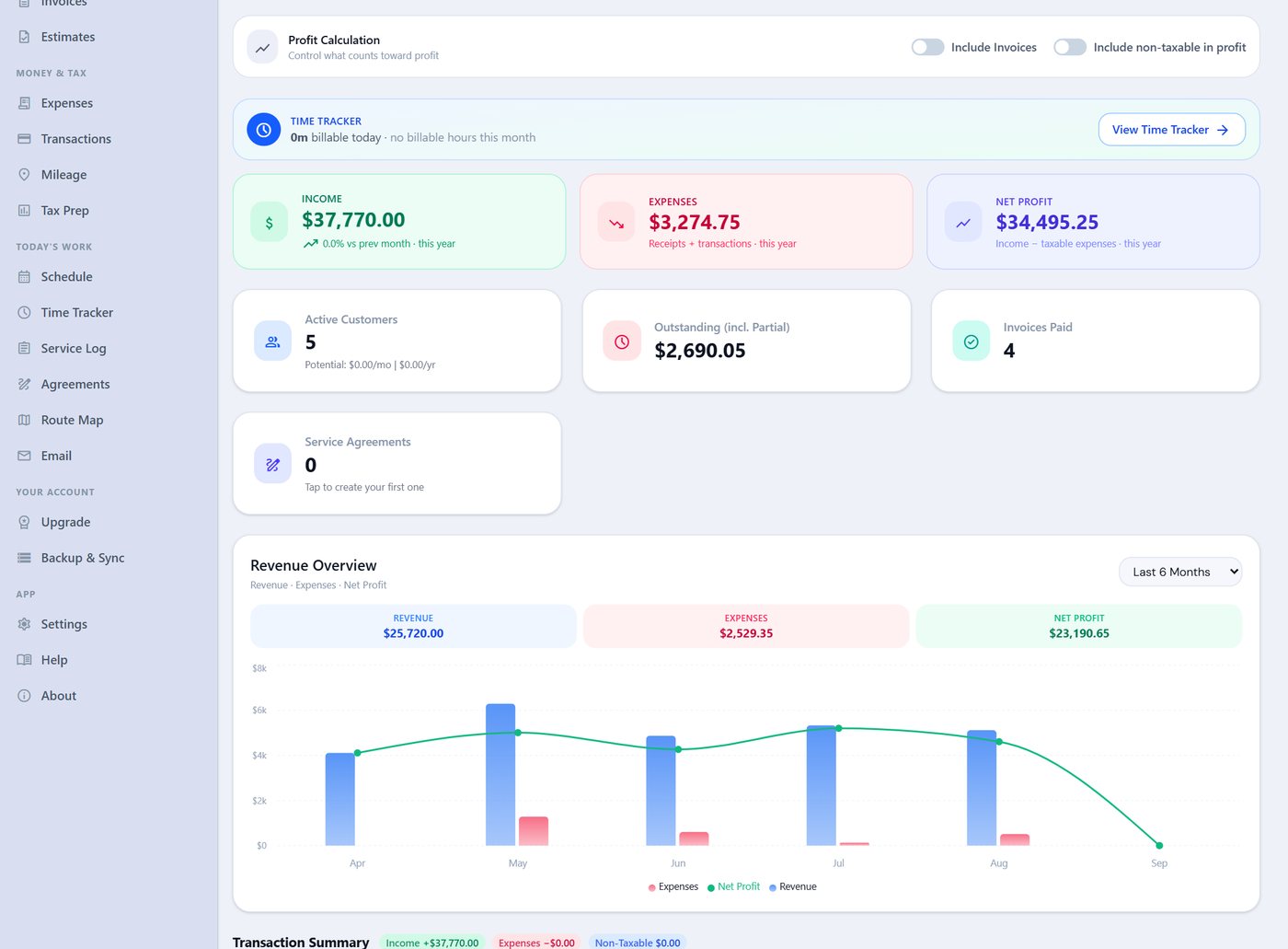
A TV mount is $276, a garbage disposal swap is $150, a threshold rebuild is $347. None of them is worth chasing hard and together they are the month's rent. The dashboard's Outstanding figure shows what is owed right now; the invoice list filters to overdue; and the Compose Email screen writes the reminder for you, friendly or firm, with the invoice attached. The bakery's threshold invoice in the example is the overdue one, at $347 since June. The reminder takes one click and usually gets paid the same day, because the invoice is there to click.
Problem 5: the tax return for a truck full of tools
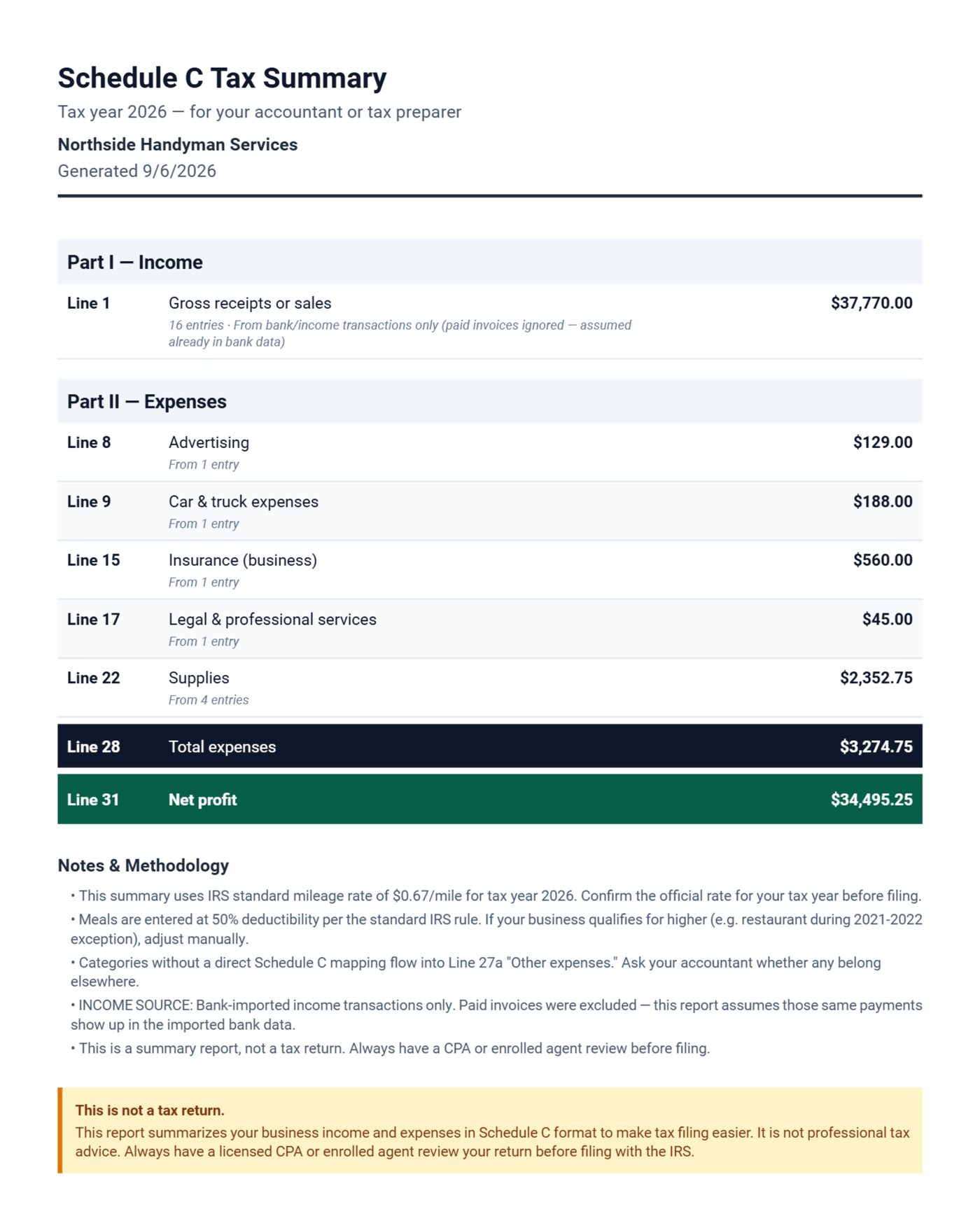
A handyman's expenses are tools, materials, the truck, insurance, parking, and lead fees. Entered as they happen (photograph the receipt and the app reads the merchant and amount), they map to the Schedule C lines at year end: tools to depreciation or supplies depending on size, materials to supplies, the truck to car and truck expenses, Thumbtack to advertising, liability to insurance. Materials you billed to a client are also income on the other side, which is why every material line belongs on the invoice.
What goes on a handyman invoice
| Line | Why |
|---|---|
| Labor as hours × rate | The rate is what the client agreed to; the hours are the record |
| Each material as its own line at cost | Clients accept what they can check |
| Handling or markup as a visible line | A stated 15 percent is fair; a hidden 30 is a fight |
| "Added on site" section | Separates the extra from the agreed scope |
| Deposit recorded as a payment | The invoice shows balance due, not the whole job |
| Receipts and photos attached | Proof for the client and for your own tax file |
| Minimum service charge when the job is tiny | The disposal swap is 1.5 hours plus the drive; say so |
What we changed after watching handymen use the app
We added the Products & Rates list because handymen were typing "caulk, $8" for the fortieth time, and we built the "Added on site" section after a customer told us the extras were the part of every job he argued about. We noticed that invoices with receipts attached were paid faster than the same invoices without them, which is why the attach button sits next to every materials line.
Common mistakes on handyman invoices
- Materials marked up silently. A client who checks one price online distrusts the whole invoice. State the handling percentage.
- No minimum charge. A 40-minute job with a 75-minute round trip billed at 40 minutes is a loss dressed as a favour.
- Customer-supplied parts on your invoice. You did not buy them, you cannot warranty them, and they inflate your income figure.
- Small invoices left past 30 days. A $347 invoice from June is rarely collected in September. The Schedule C instructions also explain why materials billed to clients must appear as both income and cost.
The bottom line
Labor as hours times rate, materials at cost with a stated handling line and receipts, a minimum charge, a deposit for materials, and one monthly invoice per property manager with their numbers on it.
FAQ
Can I charge a minimum for small jobs?
Yes. Put the minimum in Settings under Products & Rates and add it as a line, or add a "minimum service charge adjustment" line as in the disposal example. State it in your terms.
How do I keep customer-supplied materials off my books?
Do not invoice them. If the customer bought the disposal, the invoice has labor only; your expenses have nothing for it. The tax return is cleaner and so is the warranty conversation.
Do I need a written estimate for a $300 job?
Not usually, but for anything with materials over about $100 or more than half a day, yes. Illinois and several other states require written contracts for home repair above a threshold; a signed estimate covers it.
Does it track mileage between jobs?
Yes, GPS on the Android app or manual entry, at the IRS rate. For a handyman driving 30 miles a day between jobs, mileage is usually the largest deduction after tools.
Try it on next week's jobs
Download the free demo for Windows, Mac or Linux and write next week's invoices in it, starting from the Handyman job template. The licence is $149.95 once, $59.99 a year or $5.95 a month. The handyman page and the guide cover sections, deposits and the Products & Rates list.
Run a service business?
Daily Invoice Maker handles invoices, estimates, expenses, route maps, agreements, and tax reports — offline, on Windows, Mac, Linux + Android. Free demo, lifetime license available.
Download free →