HVAC Contractor Billing and Invoicing Software: Replacement Proposals, Deposits, Permits and Maintenance Agreements
How a two-van HVAC shop writes a $6,000 replacement estimate with Equipment, Parts, Labor and Permit sections, records the deposit, bills a 24-unit maintenance agreement and exports the year for tax.
In this article
- Key takeaways
- Problem 1: the replacement proposal
- Problem 2: the invoice that has to survive three years
- Problem 3: maintenance agreements and property managers
- Problem 4: the after-hours call
- Problem 5: the summer spike and the winter trough
- Problem 6: tax time with $30,000 of equipment purchases
- What an HVAC invoice needs
- What we changed after watching HVAC contractors use the app
- Common mistakes on HVAC invoices
- The bottom line
- FAQ
- Try it on your next replacement
An HVAC contractor's paperwork has to do two jobs that pull in opposite directions. A $6,000 system replacement needs a written proposal with the equipment model numbers, the permit, a deposit and a warranty registration on file, because that is what the customer, the town and the manufacturer will each ask about later. A $150 capacitor swap on a Tuesday afternoon needs an invoice written in the driveway in under a minute. Software that is good at the first is usually painful for the second, and vice versa.
This post shows how Summit Heating & Air in Chandler, Arizona handles both in Daily Invoice Maker: the replacement estimate with equipment, parts, labor and permit sections; the invoice that carries the deposit and the startup notes; a maintenance-agreement invoice for 24 apartment units; the year's profit picture; and the Schedule C summary. Every image is the app's real output for this business. The app runs on Windows, Mac and Linux ($149.95 once, $59.99 a year or $5.95 a month), and it works offline, which is the normal condition in a mechanical room.
Key takeaways
- Quote replacements with Equipment, Parts, Labor and Permits as separate sections; that is how the customer compares you to the other two bids and how the town inspector reads it.
- Put the deposit, the startup readings and the warranty registration number in the invoice notes. Three years later, that invoice is the warranty claim.
- Bill maintenance agreements as quantity × unit (24 units × $62), so the property manager sees the per-unit price they agreed to.
- Charge after-hours calls with the rate card printed in the terms; it is the line most often disputed, and it should never be a surprise.
- Sales tax on parts differs from tax on labor in most states; keep them on separate lines so the sales tax report can tell them apart.
Problem 1: the replacement proposal
Customers get three bids for a system replacement and they compare them line by line, usually at the kitchen table with all three PDFs. The bid that names the equipment (condenser model, air handler model, SEER2 rating), separates the permit and the haul-away, and states the warranty in plain words is the one that looks like it came from a real company. The Ashcroft estimate below does exactly that: a Goodman 3-ton condenser and matching air handler under Equipment, the pad, disconnect and refrigerant under Parts, 8 hours of two-tech labor, the Town of Gilbert permit as its own line, and 50 percent down with the balance on startup.
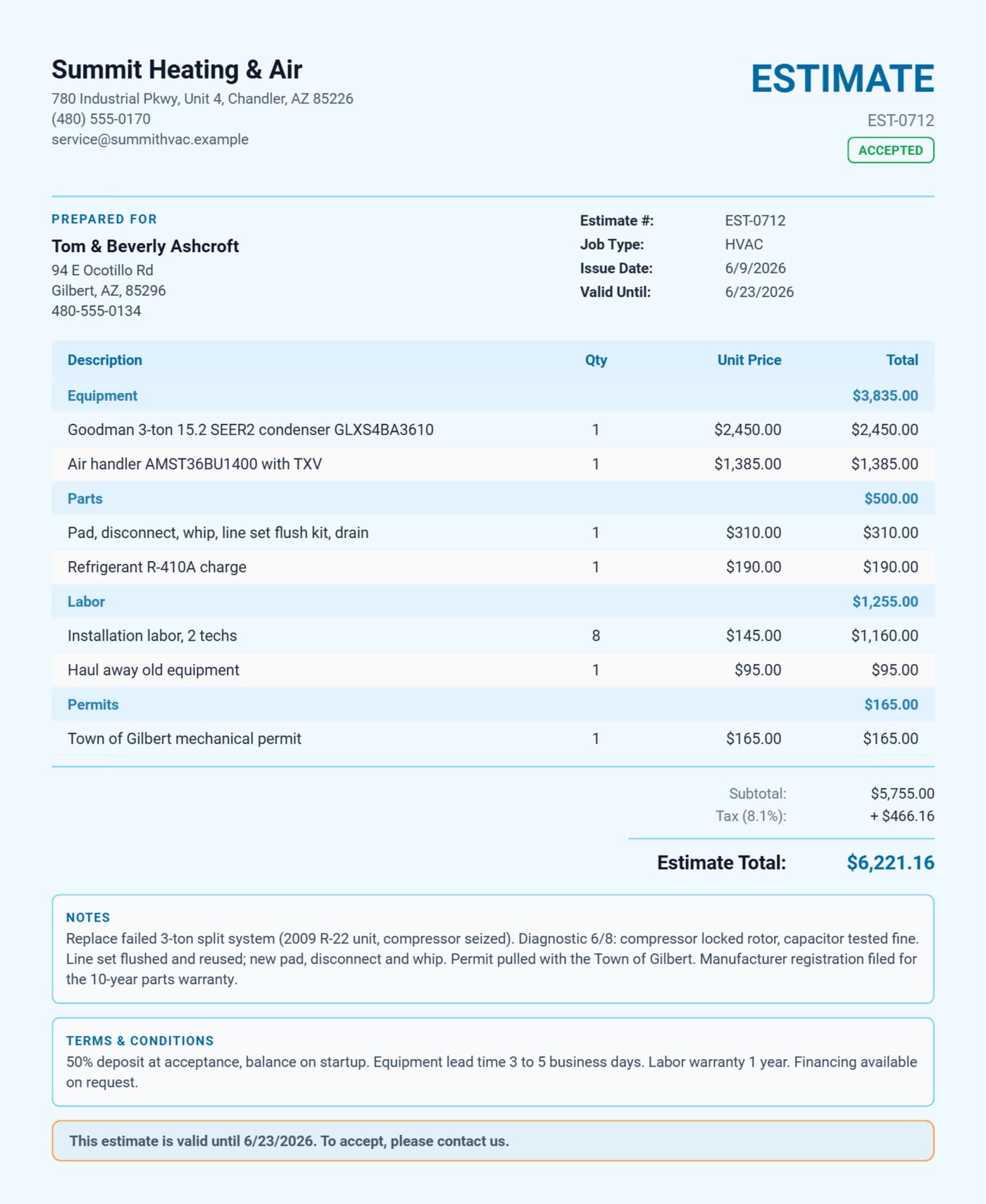
The notes carry the diagnosis (locked-rotor compressor on a 2009 R-22 unit) and the promise to file the manufacturer registration for the 10-year parts warranty. Sales tax is set per business in Settings and applied to the whole estimate here at 8.1 percent; if your state taxes parts but not labor, the sections make the split visible. The customer signs on the tablet, or replies to the email, and the estimate is marked accepted.
Problem 2: the invoice that has to survive three years
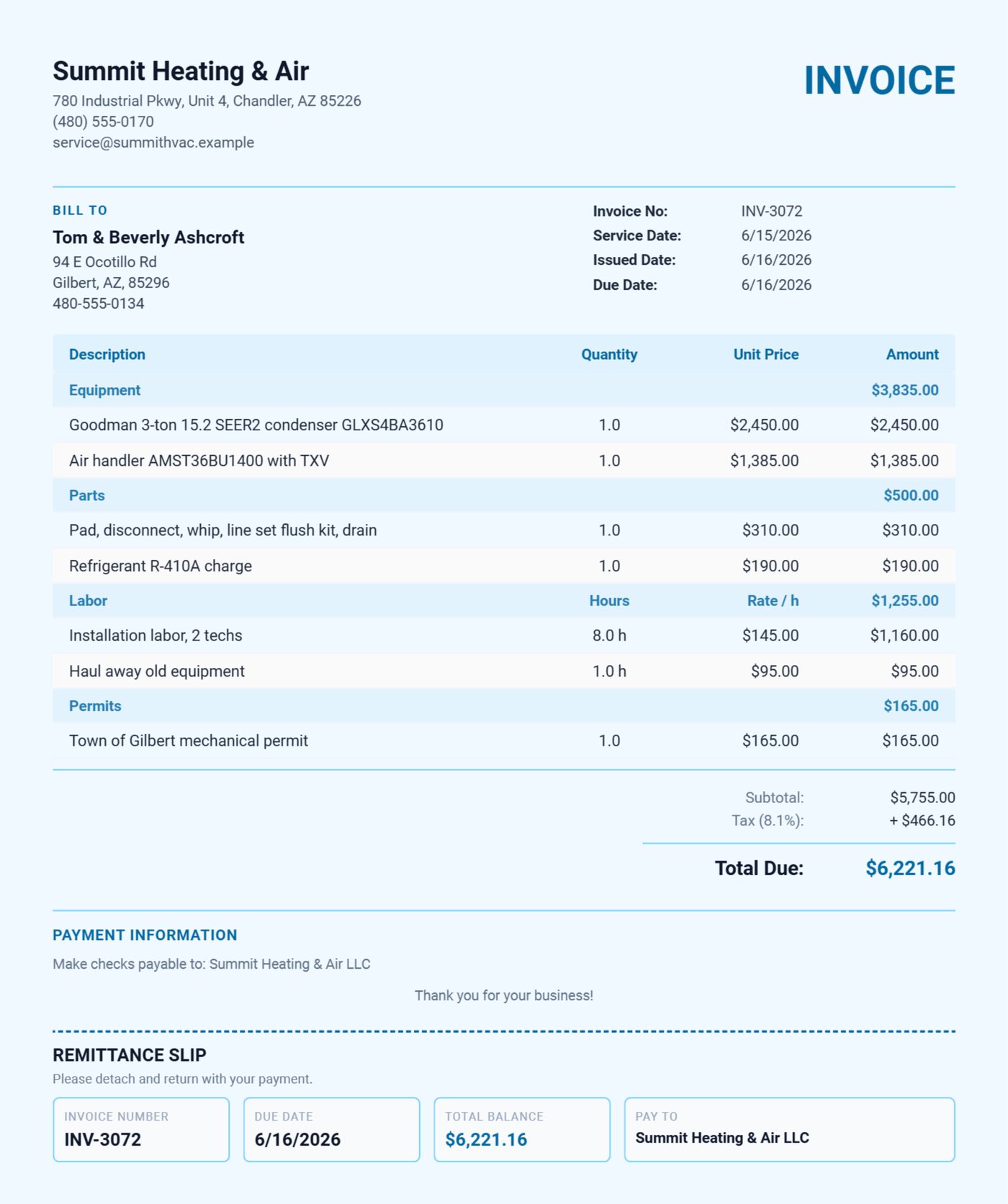
When the system is in, one tap converts the accepted estimate to the invoice. Nothing is retyped, which matters on a $6,000 job where a transposed digit is a $900 argument. Then the notes get the facts that make this invoice a record rather than a receipt: deposit received on 6/9 by check 1188, startup completed 6/15 with an 18 degree split and a 4.2 pound charge, warranty registered with Goodman under reference GDM-77231. When the compressor is claimed under warranty in 2029, everything the manufacturer asks for is on one page.
The deposit is recorded as a partial payment, so the invoice shows the amount paid and the balance due rather than pretending the customer owes the full amount twice.
Problem 3: maintenance agreements and property managers
Desert Bloom Apartments has 24 units on a spring and fall maintenance agreement at $62 a unit plus filters. The invoice is written as quantity × price, 24 × $62 and 24 × $6.50, on net 30 terms, because that is how the property manager's accounts payable reads it. When unit 14B needs a blower motor in August, that is a separate invoice with the unit number in the description, so the manager can charge it back to the right building. The Customers screen keeps the property's history, so next spring's agreement invoice is a copy of this one with the date changed.
Problem 4: the after-hours call
The walk-in cooler at Copper Kettle Cafe stopped holding temperature on a Saturday. The invoice has an after-hours call fee of $189, the condenser fan motor as a part, and 1.5 hours of labor at the after-hours rate of $165. The rate card is in the invoice terms for every commercial customer, so the owner saw the rates before he called. That invoice is the one currently overdue in the example, and the dashboard flags it: a restaurant that has already been saved once should be chased at 14 days, politely, with the invoice attached, which the Compose Email screen does in one click.
Problem 5: the summer spike and the winter trough
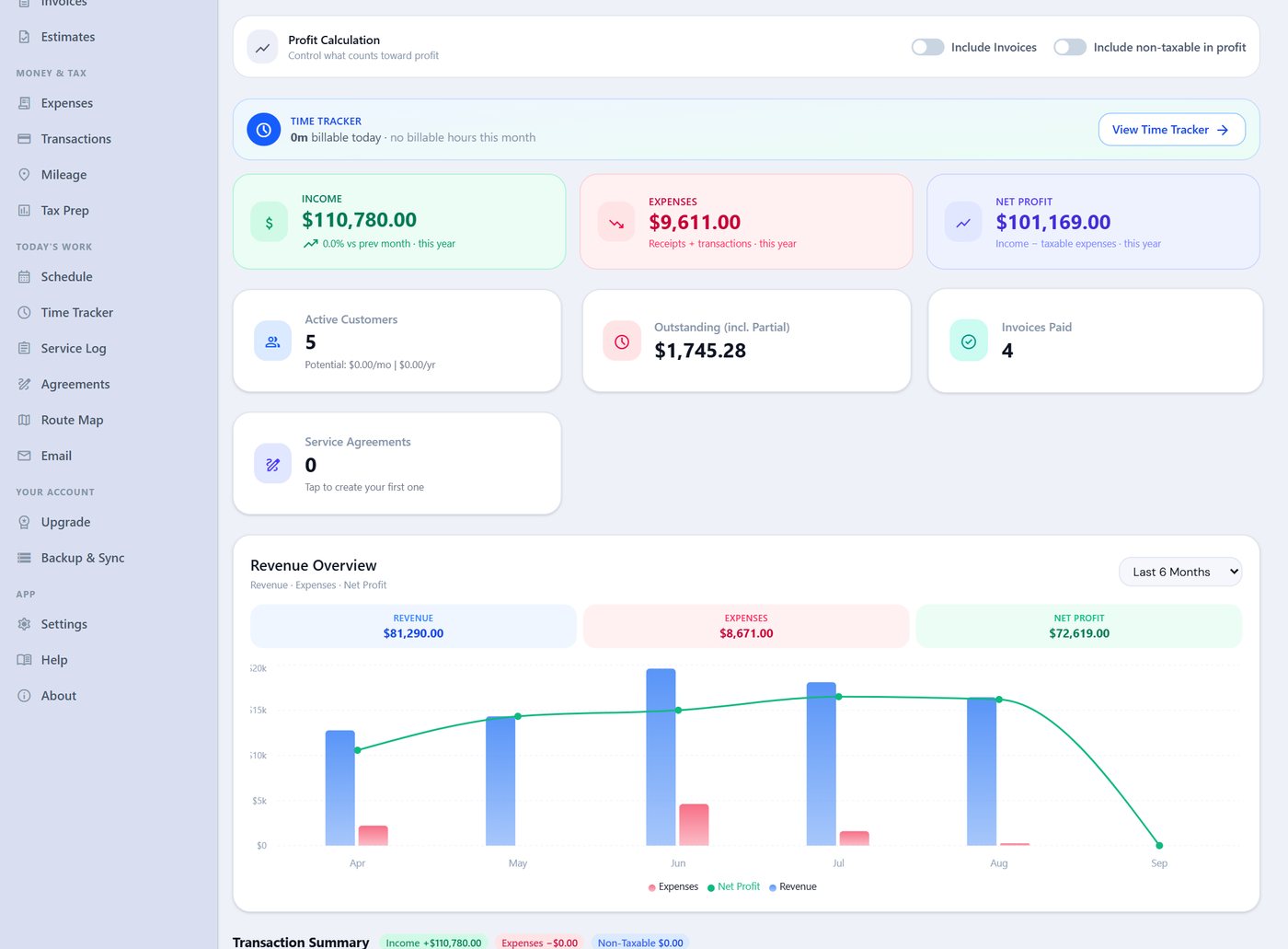
Arizona HVAC income is a summer business: Summit bills $8,000 to $9,000 a month in winter and nearly $20,000 in June. The dashboard shows the year's income, expenses and net profit and the revenue chart underneath, so the June spike and the equipment purchases that precede it are visible. Import the bank statement monthly and leave "Include Invoices" off so deposits and invoices are not double counted.
Problem 6: tax time with $30,000 of equipment purchases
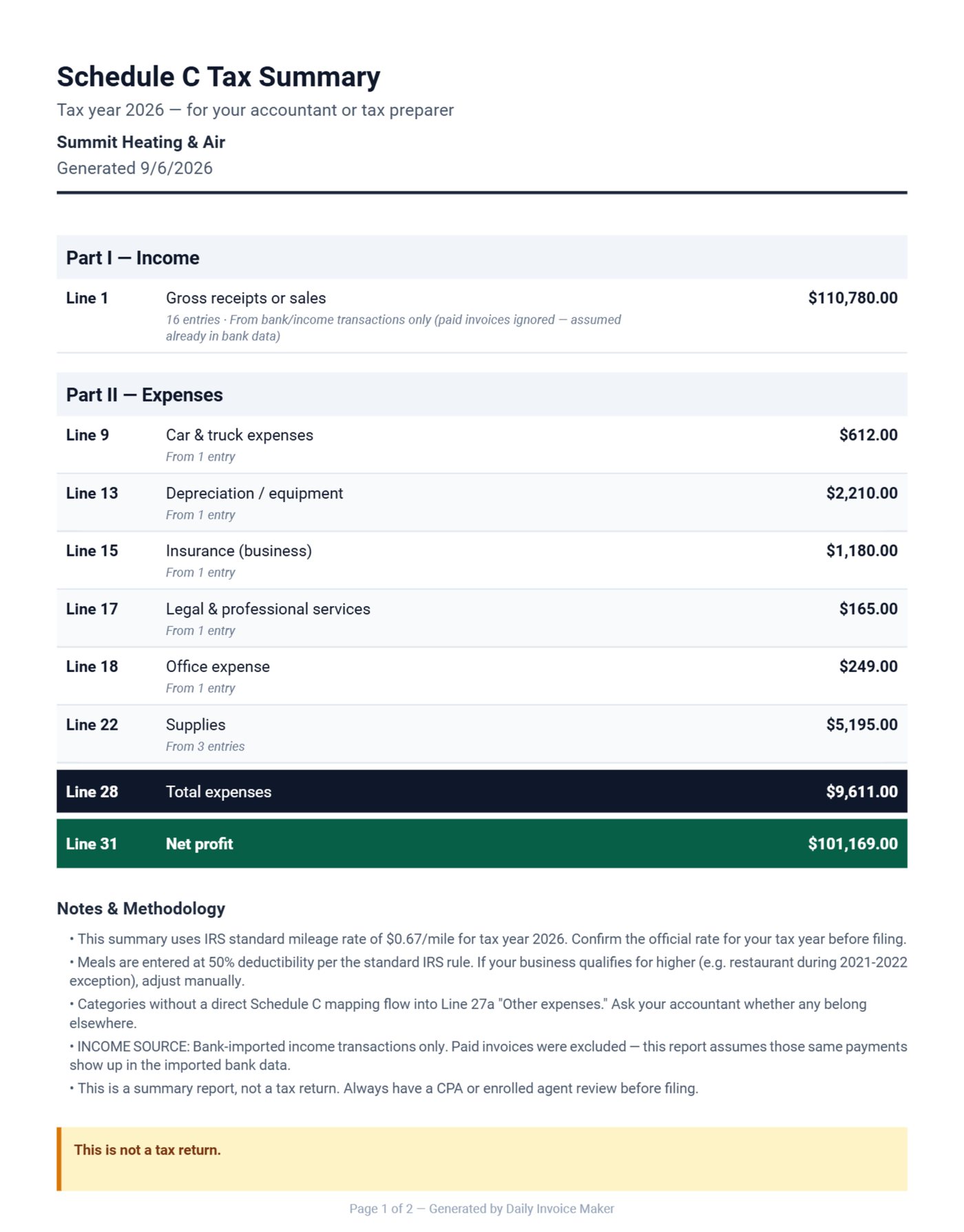
HVAC expenses are lumpy: a $3,800 system bought for one job, a $2,200 recovery machine, a $1,200 insurance quarter. Entered as they happen, with the customer name in the item ("GLXS4BA3610 + AMST36BU1400 (Ashcroft)"), they roll into a Schedule C summary where equipment for resale sits apart from tools you keep. The permit fees land on legal and professional, refrigerant on supplies, the vans on car and truck.
What an HVAC invoice needs
| Line | Why |
|---|---|
| Equipment with model numbers | Warranty claims and the inspector both need them |
| Parts separate from labor | Sales tax usually applies to one and not the other |
| Labor as hours × rate, with the rate printed | Customers accept a rate they can see |
| Permit as its own line | It is a pass-through cost, not your margin |
| Deposit recorded, balance shown | The customer never sees the full amount as still owed |
| Startup readings and registration number in notes | The invoice becomes the service record |
What we changed after watching HVAC contractors use the app
We built sections on estimates (Equipment, Parts, Labor, Permits) after an HVAC customer sent us a proposal he had formatted by hand in a word processor because his invoicing app could not separate the condenser from the labor. We added the deposit as a partial payment when we noticed installers were editing the total down to the balance and losing the record of what was paid. The startup readings and warranty registration in the notes came from a warranty claim that was refused for lack of an install date.
Common mistakes on HVAC invoices
- No model numbers. The manufacturer's warranty claim and the inspector both start with the model; "3-ton system" is not enough.
- Permit hidden in materials. A customer who finds a permit fee inside a $500 parts line questions every other line.
- Parts and labor on one line. Most states tax one and not the other; the sales tax return becomes a guess.
- Deposits above the legal cap. Some states limit contractor deposits; check your state's contractor board before the terms go on the estimate. The SBA's tax guide covers the federal side for a contractor's first year.
The bottom line
Sections on the proposal, the deposit recorded as a payment, the facts that matter in the notes, and maintenance agreements billed as quantity times unit. The invoice is then the service record, which is what an HVAC customer keeps.
FAQ
Can I show parts taxable and labor not?
The tax rate applies to the document, but parts and labor sit in separate sections, and the sales tax report in Tax Prep lists collected tax by state and rate for the return. If your state exempts labor, put labor on a separate invoice or ask your preparer how to report the split.
How do I handle financing?
Record the financed amount as a payment on the invoice when the lender funds it, and note the lender and reference in the notes. The invoice then shows paid in full with the source recorded.
Does it work in a mechanical room with no signal?
Yes. Everything is stored on the laptop or Android phone; nothing needs the internet until you email the document.
Can two techs use it?
The desktop licence covers two computers, and Google Drive sync keeps them in step. Each tech invoices from their own machine and the office sees everything.
Try it on your next replacement
Download the free demo for Windows, Mac or Linux and write your next replacement proposal in it, with the HVAC job template as a starting point. The licence is $149.95 once, $59.99 a year or $5.95 a month. The HVAC page and the guide cover estimates, deposits and the sales tax report.
Run a service business?
Daily Invoice Maker handles invoices, estimates, expenses, route maps, agreements, and tax reports — offline, on Windows, Mac, Linux + Android. Free demo, lifetime license available.
Download free →